That perfect genius Donald told the world about the bleach, the magic lights and of course, his favourite, hydoxichlorowotsit. And we all know he has perfect insight because he knows more than the doctors.
Then we get the peer reviewed report showing that it has actually got a negative effect on health. The press go crazy telling us how dumb Trump is.
Now we have new reports that the report was fake and again the press are going crazy.
One of the insights in to the foreign involvement in the social media effect on elections pointed to a method of working. It was to create arguments and confusion to make people unsure of what they are hearing.
And it all works because today we have a media that is more interested in pushing their world view than in reporting facts. Because facts and truth don’t sell.
Have you ever heard yourself say “I don’t know what to believe”. Well that is a sign you have been played by the fakers. You are listening to the wrong voices. Reminds me of the closing part of a Larry Norman song.
Posted inCOVID|Comments Off on Fake, double fake or triple fake
I remember sitting on a train from Glasgow to London. Another guy got on at carlisle and sat opposite. We got talking, and as we chatted we realised we had the same date of birth. Not only that, he was born in the same hospital.
On Christmas day in a state park near Las Vegas I met an elderly gent who told me his first job as an apprentice was to paint the house my grandparents would move in to.
I’m always fascinated by the people we bump in to in life. I don’t always (or often) keep in touch. I like the moments of passing and wish them well as they sail off in the other direction.
In my midnight walks I’ve noticed that most young people that I’ve passed have shouted hello from the other side of the street.
I don’t know who she was today. She was at her fathers grave. We spoke for a few minutes. I think she just wanted somebody to talk to about why she was there. It would have been easy to walk past. Even in this time of keeping distance between ships it was a good reminder that it can be important to say hello as we pass.
Grass doesn’t grow when it is really dry. Grass grows a lot when it is wet. Lawnmowers are terrible at cutting wet grass. We seem to have developed a tool that works best when it isn’t needed. There is a fairly obvious conflict here.
When I was looking at property in Spain I saw a small field next to the river. It came with a contract with a local goatherd who took care of the grass. I wondered if there is scope for goat rental here. Unfortunately not. Goats don’t really go for the sort of grass we grow in our lawns.
In fact, why do we grow lawns? What is it with the sort of grass we grow? When planting my tree recently I spotted that the soil under my lawn is only about 5cm thick. It really needs to be another 10cm thicker. It helped me understand why my lawn is not really going to improve much unless I remove it and put a thick layer of soil underneath. So it got me to thinking about why I try to grow a lawn – why do I try to force something to grow that isn’t natural in the local soil?
It got me wondering about what else I try to force in life that is against some sort of “natural order”. Maybe this is a good time to get rid of them. Or will it never be right to break wind in an elevator?
Yes, there have been cases of coronavirus at Walkers crisps. Is it now time for crisp wars? As I traveled abroad I have seen very few countries that have such a crisp lust as the UK. We each eat an average of 3.5 kg per year. Only Ireland eats more per capita in Europe.
But the most interesting difference I have seen is the range of flavours. Last time I was in Spain I found a shop that sold Prawn Cocktail, but I have not seen them in many other countries. I think I mentioned my trip to Kazakhstan, going for a walk in the city and finding a cafe that sold Russian tea and crisps. Not reading Russian I bought a packet, only to discover they were caviar flavoured. Never found them anywhere else.
I’m sure this outbreak will not stop Walkers producing, but I think I might start hoarding. That will leave me with toilet paper, hand sanitiser, Marmite and crisps. I need to stop – I can’t dig many more storage pits in my garden.
Quite interesting comedy tonight. I like the comedies that cover serious issues. Fletcher gave a monologue on Porridge about the old school tie benefits of our society. Did you know that Gordon Brown is the only prime minister in the last 80 years that didn’t attend Oxford university? Is it changing, well according to the Sutton Trust the Boris cabinet has twice as many private school buddies as the May cabinet.
It feels like a lot of people think normal is back. People are getting back to normal – except Leicester. Truth is there are likely to be a lot more Leicesters in the future. Now think about what that means – how can you plan for the future when you can be closed down at a weeks notice.
The prediction is that a third of cars will be on the road this weekend. People are going to travel for a weekend away.
Personally I think it is time to stock up on the Marmite. You see there is a lag on some things. The base material for Marmite comes from beer production, which has been low for a while. So we will have a period of building up supplies. So the game will be to predict what the next toilet roll war will be about
I have about 160 onions coming on – and my cousin tells me he has a few hundred potatoes. One thing we are all going to have a glut of is home grown veg. Flour is still in short supply because we are all baking so much more.
No, normal is not coming back that soon. Some good, some bad. Some changes will stay, some will revert to the way it was. The thing that struck me is that we will need to work hard – to change a lot – just to stay where we are.
Posted inCOVID|Comments Off on Half a year, half a year, half a year onward.
So how is the UK doing? If you want to read all of the data for every goal you can look at the national report (always remember we will make this look good for us). I’ve picked out a few interesting points.
Goal 1. No poverty. Compared to the rest of the world this is a fairly pointless measure for the UK. The level of inequality in the UK has reduced since the 1800s in the UK, however since the mid 1970s it has started to rise again (no matter the flavour of government). This is one of the things I spotted while looking at the data – sometimes all the political screaming is none-sense compared to the data.
One of the measures of this goal relates to spending on healthcare. I know – sounds more like goal 3. But an interesting fact is the the public healthcare spending in the UK is a smaller proportion of government spending (or GDP) than most other western countries (including the USA!). In countries like the USA this is supplemented by private spending at about the same level. However the level of health achieved with the spending is about the same. This means we get more bang for our bucks than many other countries – our NHS is a very effective way of delivering health care.
Goal 5 Gender equality. Generally the level of pay inequality has been changing at a reasonably fast rate. Sounds good. But when you drill in to the figures you find that the level of gender pay inequality rises quickly as you get to the highest levels of pay. So women make up 30% of the top 10% of earners, but only 10% of the top 0.1% of earners.
Goal 12 Responsible consumption. The UK has been improving in this area, but the most striking thing to me was the comparison with our near neighbours. We are one of the best countries in Europe and are steadily improving. We are often told how amazing Germany is – but their consumption is about twice ours per capita – and they have hardly changed over the last 20 years.
My impression over the years of listening to news and politics simply does not match with the measurements. I guess the answer is to listen to the science. All of this information is readily available to us. Next time you hear something about “could do better” or “fantastic record” try looking up the SDG tracker.
Tesco delivery – Marmite back in stock – only got 500g, should be enough for a couple of weeks.
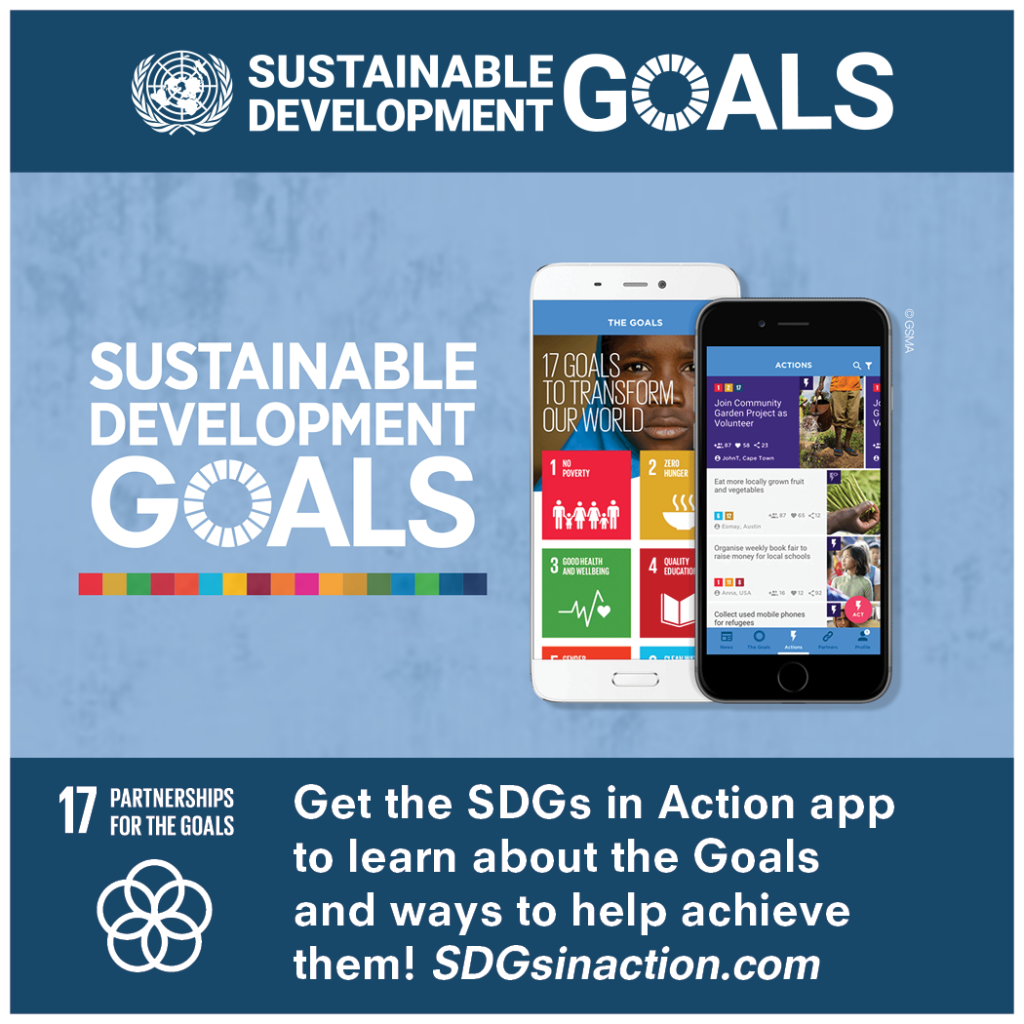
The final SDG is number 17 “Partnerships for the goals” or to be less concise “Strengthen the means of implementation and revitalize the global partnership for sustainable development”.
This goal is as much about the structure around achieving the other goals as anything else. The specific targets are:
Finance
Strengthen domestic resource mobilization, including through international support to developing countries, to improve domestic capacity for tax and other revenue collection
Developed countries to implement fully their official development assistance commitments, including the commitment by many developed countries to achieve the target of 0.7 per cent of ODA/GNI to developing countries and 0.15 to 0.20 per cent of ODA/GNI to least developed countries ODA providers are encouraged to consider setting a target to provide at least 0.20 per cent of ODA/GNI to least developed countries
Mobilize additional financial resources for developing countries from multiple sources
Assist developing countries in attaining long-term debt sustainability through coordinated policies aimed at fostering debt financing, debt relief and debt restructuring, as appropriate, and address the external debt of highly indebted poor countries to reduce debt distress
Adopt and implement investment promotion regimes for least developed countries
Technology
Enhance North-South, South-South and triangular regional and international cooperation on and access to science, technology and innovation and enhance knowledge sharing on mutually agreed terms, including through improved coordination among existing mechanisms, in particular at the United Nations level, and through a global technology facilitation mechanism
Promote the development, transfer, dissemination and diffusion of environmentally sound technologies to developing countries on favourable terms, including on concessional and preferential terms, as mutually agreed
Fully operationalize the technology bank and science, technology and innovation capacity-building mechanism for least developed countries by 2017 and enhance the use of enabling technology, in particular information and communications technology
Capacity building
Enhance international support for implementing effective and targeted capacity-building in developing countries to support national plans to implement all the sustainable development goals, including through North-South, South-South and triangular cooperation
Trade
Promote a universal, rules-based, open, non-discriminatory and equitable multilateral trading system under the World Trade Organization, including through the conclusion of negotiations under its Doha Development Agenda
Significantly increase the exports of developing countries, in particular with a view to doubling the least developed countries’ share of global exports by 2020
Realize timely implementation of duty-free and quota-free market access on a lasting basis for all least developed countries, consistent with World Trade Organization decisions, including by ensuring that preferential rules of origin applicable to imports from least developed countries are transparent and simple, and contribute to facilitating market access
Systemic issues
Policy and institutional coherence
Enhance global macroeconomic stability, including through policy coordination and policy coherence
Enhance policy coherence for sustainable development
Respect each country’s policy space and leadership to establish and implement policies for poverty eradication and sustainable development
Multi-stakeholder partnerships
Enhance the global partnership for sustainable development, complemented by multi-stakeholder partnerships that mobilize and share knowledge, expertise, technology and financial resources, to support the achievement of the sustainable development goals in all countries, in particular developing countries
Encourage and promote effective public, public-private and civil society partnerships, building on the experience and resourcing strategies of partnerships
Data, monitoring and accountability
By 2020, enhance capacity-building support to developing countries, including for least developed countries and small island developing States, to increase significantly the availability of high-quality, timely and reliable data disaggregated by income, gender, age, race, ethnicity, migratory status, disability, geographic location and other characteristics relevant in national contexts
By 2030, build on existing initiatives to develop measurements of progress on sustainable development that complement gross domestic product, and support statistical capacity-building in developing countries
A lot of this is outside our control. We all see calls to support charities, and they are normal really good causes. The issue around this goal is making sure we address ALL the goals. They are inter-related and each of them is important. If we invest all of our funds in climate change and nothing in hunger that would be a disaster.
National funding is reducing and trade wars make it hard to deliver specific goals. Private support is good, but they seldom take a holistic picture and instead focus on narrow subjects. They then do not align with the funding pattern needed.
Recently there has been a fuss about the government reshuffle of responsibilities for aid. However, in real terms the UK has increased giving by over 20% since the conservative government has taken power, and double that of the Blair era. Not what you might think? One of the really important things we can do is to be aware of the facts.
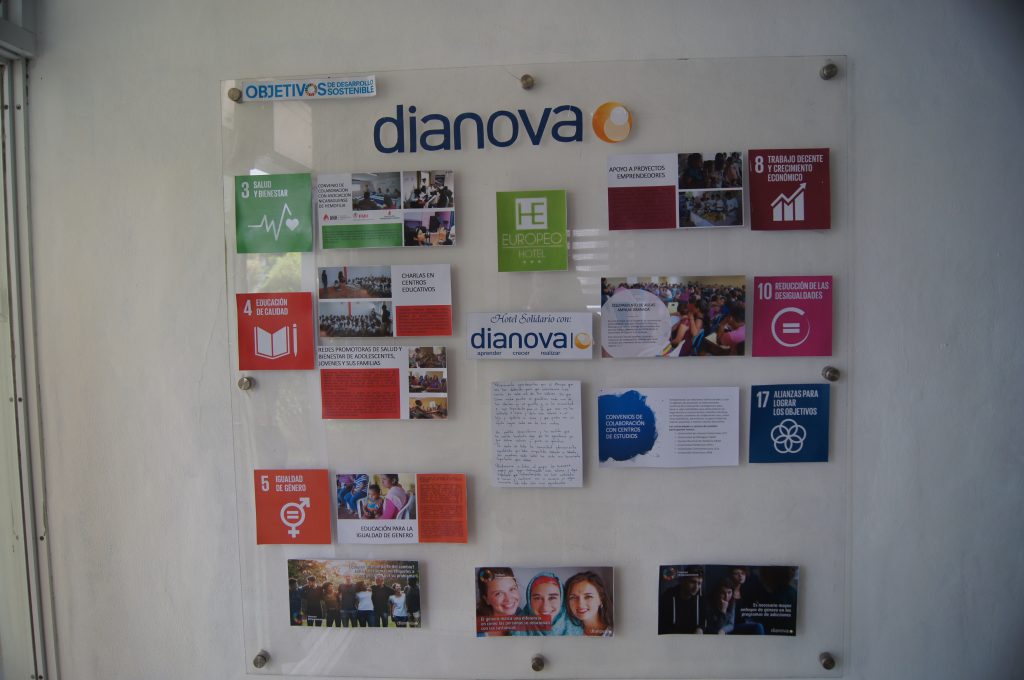
The first hotel we stayed at in Nicaragua had a notice board.
SONY DSC
You can see that they have assessed their activities against the SDGs. One thing we can all do is to assess our workplaces against the goals. Give it a try – you might find things that can be changed.
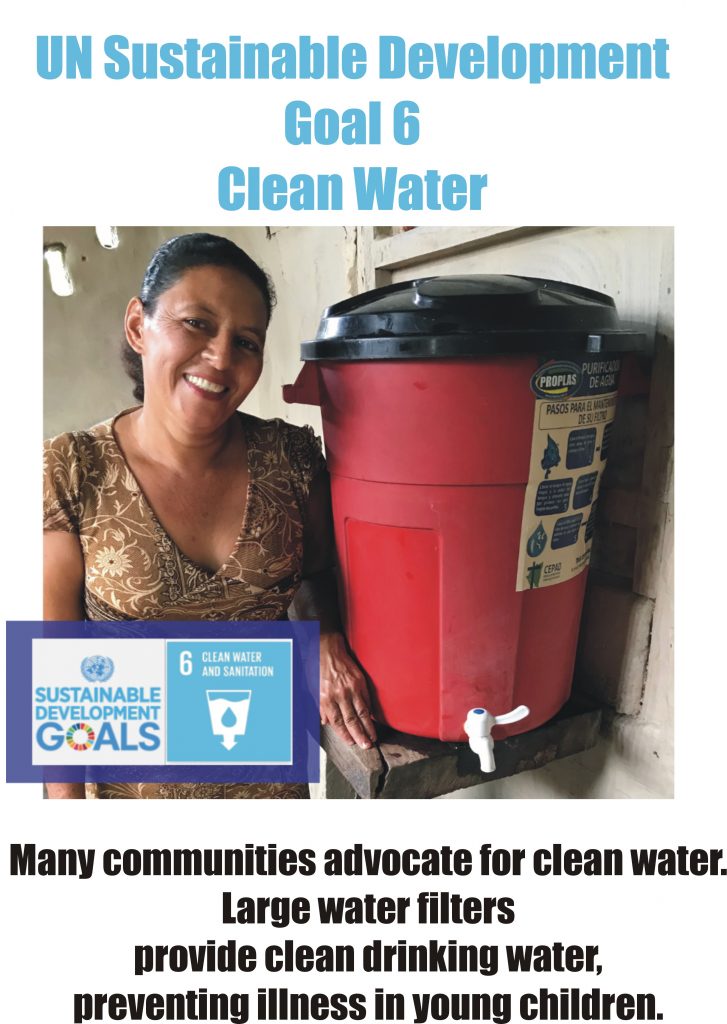
There are also charities that try to link their activities against the goals. Like CEPAD:
I think tomorrow I’ll focus on becoming aware of how the UK measures up – making ourselves aware of facts is important.
Posted inCOVID|Comments Off on Partnerships for the goals
My spare part for my coffee maker arrived from Italy. I needed to replace my single cup maker – I needed to drink weaker coffee. Now back on to a reasonable strength brew. It was raining today so I decided to have a daytime walk – great – nobody around.
Tonight the SDG is number 16 Peace, Justice and Strong Institutions or to give it the full title “Promote peaceful and inclusive societies for sustainable development, provide access to justice for all and build effective, accountable and inclusive institutions at all levels”
The individual targets are:
Significantly reduce all forms of violence and related death rates everywhere
End abuse, exploitation, trafficking and all forms of violence against and torture of children
Promote the rule of law at the national and international levels and ensure equal access to justice for all
By 2030, significantly reduce illicit financial and arms flows, strengthen the recovery and return of stolen assets and combat all forms of organized crime
Substantially reduce corruption and bribery in all their forms
Develop effective, accountable and transparent institutions at all levels
Ensure responsive, inclusive, participatory and representative decision-making at all levels
Broaden and strengthen the participation of developing countries in the institutions of global governance
By 2030, provide legal identity for all, including birth registration
Ensure public access to information and protect fundamental freedoms, in accordance with national legislation and international agreements
Strengthen relevant national institutions, including through international cooperation, for building capacity at all levels, in particular in developing countries, to prevent violence and combat terrorism and crime
Promote and enforce non-discriminatory laws and policies for sustainable development
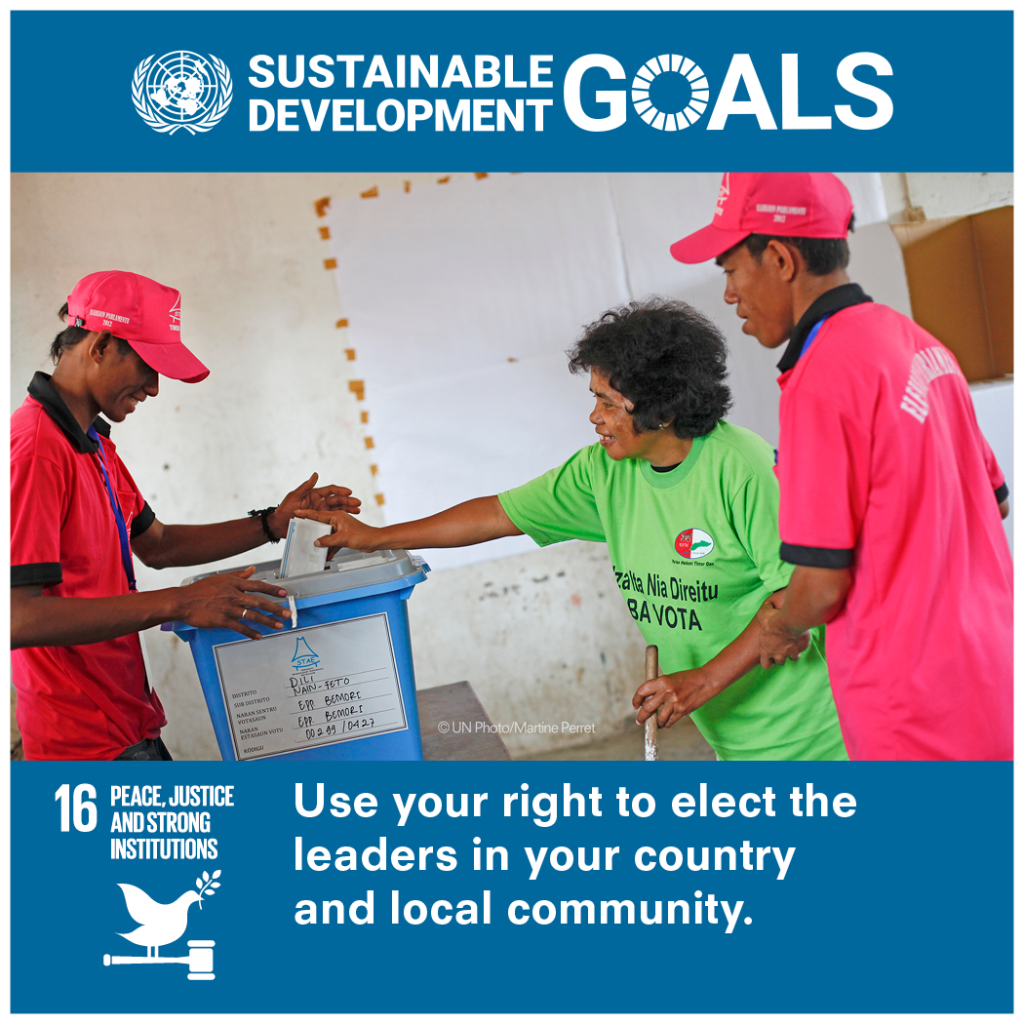
A lot of these targets seem to be about criminal acts and a sound legal and political base for society. But there are two that stand out for me. The film Selma comes to mind – restricting the ability to participate in civil society by some means. In fact as we near the 4th July it is worth thinking about the USA revolutionary cry “no taxation without representation”.
A quarter of all children under 5 have no birth registration. Without birth registration how do you register for anything (like the ability to vote). One charity that is working to improve the situation is Toybox.
The second area are the discriminatory nature of some systems. In Selma it was racial bias in the voting system. Of course this is all gone with the victory Martin Luther King won. Or is it? In the recent votes in Kentucky the number of polling stations were cut by 95% People were taking an hour to find parking and an hour to get in to the polling stations.
Perhaps the saddest thing is that we take a lot of these institutions for granted . We complain about them, we ignore them, but actually they are available and answerable to us. We need to vote.
There are a number of concerning indicators – such as the fast growth of online sexual abuse (from 1 million to 45 million between 2014 to 2018). With the large companies pulling adverts from on-line channels perhaps this is our big chance to clean up the internet.
Another difficult statistic is the number of people in prison that have not been sentenced. We are sure “those” countries are bad, but in Europe there are two countries where there are more than 40% of people in prison who have not been sentenced – and Canada is close behind. In England and Wales this amounts to only 11%.
Maybe a letter to your MP on cleaning the internet might be appropriate – and remember to vote – even if it is just to spoil your vote.
Posted inCOVID|Comments Off on Peace, Justice and Strong Institutions
Relaxation day today – too much work last week. Interesting links on Facebook to stuff I am working on from a friend of a friend. The world is small.
Soup day today, thankfully had my Marmite delivery. It was tough – it really tasted so good I found it hard to stop sampling it. Not all my cooking has gone so well. I had a minor accident a few days ago with a tray from my oven – burned my arm. It was looking a bit nasty until I switched to hydrocolloid plasters. Amazing rate of healing.
SDG Goal 15 tonight “Life on Land” – Protect, restore and promote sustainable use of terrestrial ecosystems, sustainably manage forests, combat desertification, and halt and reverse land degradation and halt biodiversity loss
Quite a mouthful – and hard to untangle from some of the previous goals like Sustainable Cities, Responsible Consumption and Climate Action.
The individual targets are quite broad, but I see some ideas around farming and natural habitats in them:
By 2020, ensure the conservation, restoration and sustainable use of terrestrial and inland freshwater ecosystems and their services, in particular forests, wetlands, mountains and drylands, in line with obligations under international agreements
By 2020, promote the implementation of sustainable management of all types of forests, halt deforestation, restore degraded forests and substantially increase afforestation and reforestation globally
By 2030, combat desertification, restore degraded land and soil, including land affected by desertification, drought and floods, and strive to achieve a land degradation-neutral world
By 2030, ensure the conservation of mountain ecosystems, including their biodiversity, in order to enhance their capacity to provide benefits that are essential for sustainable development
Take urgent and significant action to reduce the degradation of natural habitats, halt the loss of biodiversity and, by 2020, protect and prevent the extinction of threatened species
Promote fair and equitable sharing of the benefits arising from the utilization of genetic resources and promote appropriate access to such resources, as internationally agreed
Take urgent action to end poaching and trafficking of protected species of flora and fauna and address both demand and supply of illegal wildlife products
By 2020, introduce measures to prevent the introduction and significantly reduce the impact of invasive alien species on land and water ecosystems and control or eradicate the priority species
By 2020, integrate ecosystem and biodiversity values into national and local planning, development processes, poverty reduction strategies and accounts
Mobilize and significantly increase financial resources from all sources to conserve and sustainably use biodiversity and ecosystems
Mobilize significant resources from all sources and at all levels to finance sustainable forest management and provide adequate incentives to developing countries to advance such management, including for conservation and reforestation
Enhance global support for efforts to combat poaching and trafficking of protected species, including by increasing the capacity of local communities to pursue sustainable livelihood opportunities
One of the shocking facts is the number of species threatened with extinction is growing with time – so we are driving in reverse for this. The red list is a good way to keep track of this. If you go the website there is an option for support.
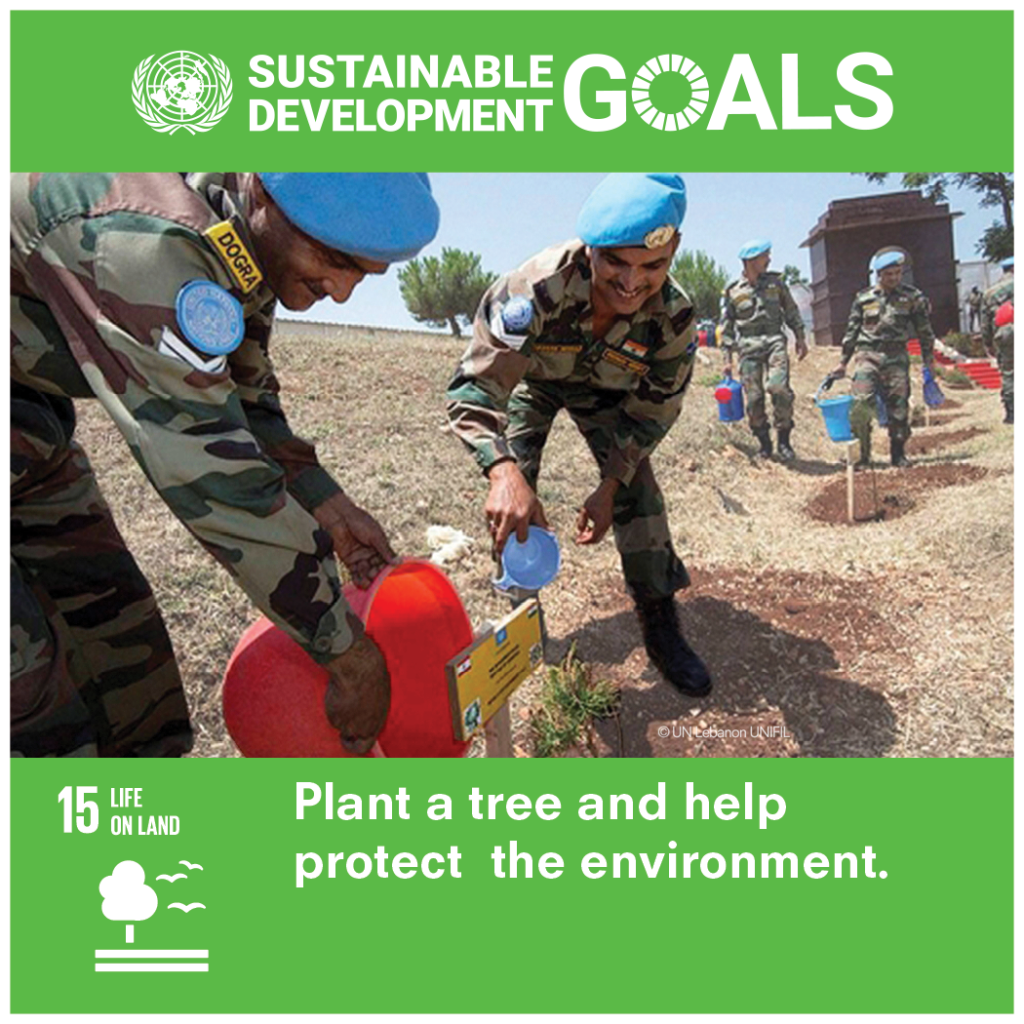
But there is the simple action suggested in the graphic that we can do – plant a tree. I have another 8 to plant this year.
Land use is resulting in degradation of the land – and this is hitting 20% of out land. Worth looking for a charity that supports reconstruction of the land.
One of the markers of how the economy is developing is transport, the area I work in. Today was the busiest day of the year so far. I only work part time – but it took me till 8pm to finish today.
And it was hot – the sort of day when you close the windows to keep the heat out – even if it is raining.
I managed to take some time out to connect with a friend – sounds like he has a really interesting charity work setting up.
The SDG tonight is number 14 Life Below Water “Conserve and sustainably use the oceans, seas and marine resources for sustainable development”.
This is something people have trouble with in terms of boundaries. We often talk about “our fishing grounds”. But actually fish don’t have passports, they don’t respect lines we draw on maps. Fish like Tuna migrate long distances. Thankfully we have international treaties requiring us to manage resources – shame we tend to bend the rules.
The targets for this goal are:
By 2025, prevent and significantly reduce marine pollution of all kinds, in particular from land-based activities, including marine debris and nutrient pollution
By 2020, sustainably manage and protect marine and coastal ecosystems to avoid significant adverse impacts, including by strengthening their resilience, and take action for their restoration in order to achieve healthy and productive oceans
Minimize and address the impacts of ocean acidification, including through enhanced scientific cooperation at all levels
By 2020, effectively regulate harvesting and end overfishing, illegal, unreported and unregulated fishing and destructive fishing practices and implement science-based management plans, in order to restore fish stocks in the shortest time feasible, at least to levels that can produce maximum sustainable yield as determined by their biological characteristics
By 2020, conserve at least 10 per cent of coastal and marine areas, consistent with national and international law and based on the best available scientific information
By 2020, prohibit certain forms of fisheries subsidies which contribute to overcapacity and overfishing, eliminate subsidies that contribute to illegal, unreported and unregulated fishing and refrain from introducing new such subsidies, recognizing that appropriate and effective special and differential treatment for developing and least developed countries should be an integral part of the World Trade Organization fisheries subsidies negotiation
By 2030, increase the economic benefits to Small Island developing States and least developed countries from the sustainable use of marine resources, including through sustainable management of fisheries, aquaculture and tourism
Increase scientific knowledge, develop research capacity and transfer marine technology, taking into account the Intergovernmental Oceanographic Commission Criteria and Guidelines on the Transfer of Marine Technology, in order to improve ocean health and to enhance the contribution of marine biodiversity to the development of developing countries, in particular small island developing States and least developed countries
Provide access for small-scale artisanal fishers to marine resources and markets
Enhance the conservation and sustainable use of oceans and their resources by implementing international law as reflected in UNCLOS, which provides the legal framework for the conservation and sustainable use of oceans and their resources, as recalled in paragraph 158 of The Future We Want
In reality we know very little about what lives in the sea – some estimates are that we might only have identified 10% of the species in the oceans. I remember helping out with one deep sea investigation looking at causes of ships sinking. The investigation was using a deep sea remote vehicle to take images. On that short investigation there were several new species asked for selfies – maybe as important a discovery as the causes of the ship sinking.
But we do know that of the fish we know the levels are dropping – in the last 40 years more than 20% of species have dropped below the sustainability levels. Ocean acidity is rising.
But it isn’t all bad news. Over the last 35 years the main international convention (UNCLOS) has been signed by over 160 countries.
We can certainly do what the graphic suggests and use less plastic to protect the seas – but we could also learn from countries like India who have banned single use plastic on ships in their territorial waters.
There has just been a webinar this week on the subject- you can watch the recording (almost 2 hours – and you might need to understand more than one language).